
Connect With Us
The Current

Our Insights

May 24, 2026

STORY OF THE WEEK

SpaceX Sends their Registration Statement into Orbit

The S-1 filed with the SEC this week reveals a profitable satellite business funding AI buildouts, with interplanetary ambitions.
SpaceX Sends their Registration Statement into Orbit

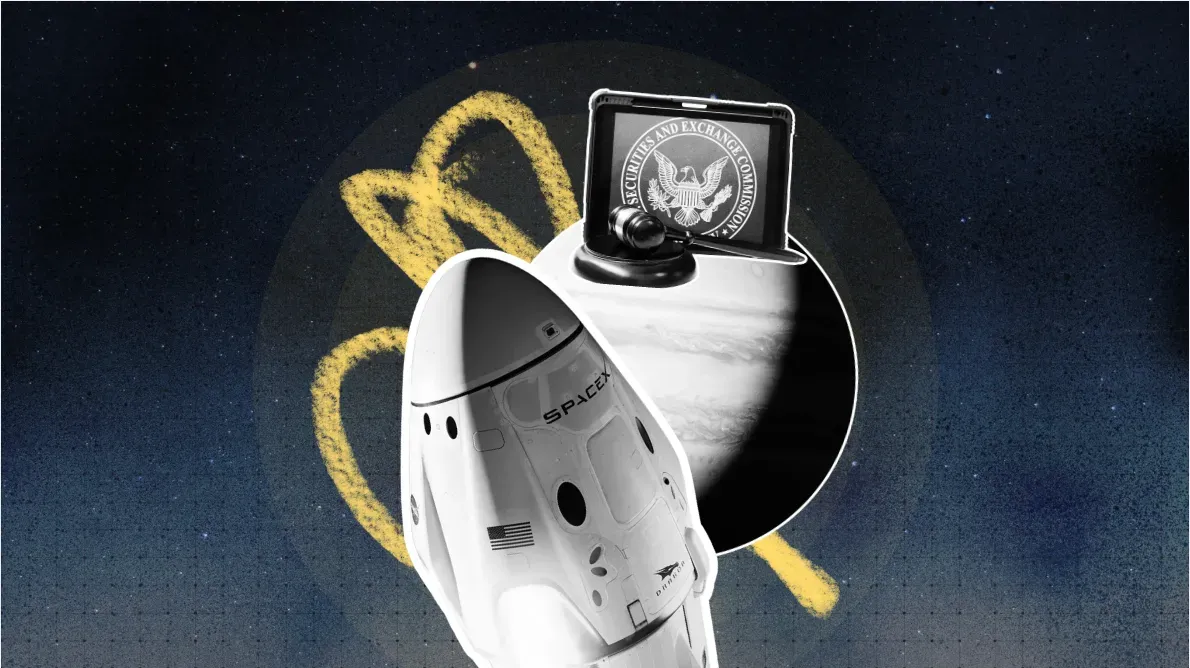
Starlink is the story inside the S-1. SpaceX's satellite internet business generated $11.4 billion in revenue and $7.2 billion in adjusted EBITDA in 2025, with operating income more than doubling year over year as subscriber growth and enterprise adoption scaled. That profitability is what makes the rest of the company possible as it covers the $657 million operating loss in the space segment and funding an aggressive push into territory most aerospace companies have never entered.

That territory is AI. SpaceX is pitching itself not as a rocket company with a side business, but as a future platform for orbital computing infrastructure, ultimately deploying solar-powered AI compute capacity in space to sidestep terrestrial energy and cooling constraints. The ambition comes at a cost: the AI segment posted a $6.4 billion operating loss on $3.2 billion in revenue in 2025, with capital expenditures reaching $12.7 billion. On a consolidated basis the company swung from a $791 million profit in 2024 to a net loss of nearly $5 billion, a trajectory that frames the IPO as a long-duration bet on technologies the filing itself acknowledges may take decades to prove out.

  • Musk holds 85.1% of voting power through a dual-class structure; Class A public shareholders cannot remove him as CEO, CTO, or chairman.

  • Consolidated adjusted EBITDA of $6.6 billion masks a $2.6 billion operating loss and a net loss of nearly $5 billion driven by $12.7 billion in AI capex.

  • Federal agencies represent roughly a fifth of total revenue, a concentration that ties financial performance directly to Musk's political standing in Washington.

The filing targets a June 12 Nasdaq debut at a valuation of $1.75 to $2 trillion, which would rank as the largest IPO in market history. Bulls see Starlink's cash generation as a durable foundation; skeptics see a multiple running decades ahead of any orbital AI revenue.
CLIMBS OF THE WEEK

What's Up in the Markets

What's Up in the Markets

IONQ (+22.5%): Funding awards proposed this week by the Commerce Department drove quantum momentum.

SPOT (+18.9%): The stock rallied after the company set ambitious financial targets and new products at their Investor Day.

ZS (+13.2%): An acquisition announcement and renewed investor optimism surrounding cyber security drove the company higher this week.

SLIDES OF THE WEEK

What's Down in the Markets

What's Down in the Markets

INTU (-18.6%): Slid this week despite strong results, guidance, and workforce cuts were announced on their earnings call.

WMT (-8.5%): Increasing fears related to consumer strength spooked investors of the retailer.

CBRS (-8.2%): Despite starting the week on a fast track for index inclusion, the momentum wore down as investors weigh the high valuation.

CHART OF THE WEEK

Where Quantum Actually Wins Against AI

Where Quantum Actually Wins Against AI

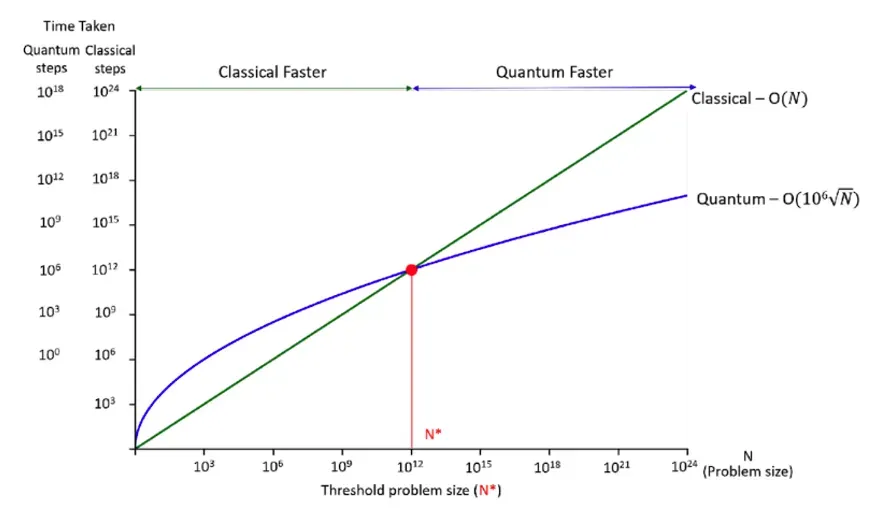
Quantum computing's reputation for disrupting AI rests on a fundamental misreading of where it actually wins. Every quantum algorithm carries a built-in overhead penalty of roughly 10⁶ additional computational steps before it processes a single unit of real work. Classical processors only lose ground once problem size crosses approximately 10¹², a threshold AI workloads rarely approach. Neural network training is matrix multiplication at scale, a task GPUs were architected to dominate. Quantum offers nothing there.

The genuine disruption lies elsewhere. Problems that scale exponentially for classical machines sit squarely in quantum's advantage zone: cryptographic factoring, molecular simulation, and large-scale combinatorial optimization. Breaking RSA encryption, modeling protein folding without approximation, solving logistics problems that would take classical hardware millennia to resolve. These are the real targets. The AI infrastructure buildout stays GPU denominated. Quantum's moment, when it arrives, will surface in chemistry labs and defense agencies before it ever touches a data center.

The Current